Do you know what your “sphere of influence” is?
What, or who, are you responsible for? As a parent, that would be your kids. As a teacher, your students. It might be the people in your bible study or your small group, it might be the children who come to stay in your cabin at camp, or sometimes extended family members like nieces, nephews, grandkids, or cousins.
In my case, I’m responsible for my relationship with my children and my husband, for how I act toward them and how I may influence their lives. I’m also responsible for the kids who come to my home for piano and voice lessons, and responsible to their parents, for how I teach, what I talk about, my attitude, and even the state of my home when they walk in. Are they able to relax and be comfortable? Or is the bathroom a disaster, the couch full of crumbs? Am I kind, polite, engaging and do I teach to the best of my ability?
On their end, the students are responsible to learn, to practice (at least a little!) to behave and listen (within reason) and do their best during the lesson. Sometimes they aren’t feeling well or had a bad day, and we adjust. Expectations lower, and we do what we can without pushing too hard.
As someone who often struggles with being over responsible, I’ve had to think hard about when and why I tend to be that way. Author and blogger Natalie Rue says “over-responsibility is the unhealthy habit of taking ownership of others’ actions, emotions, and tasks, often driven by anxiety, perfectionism, or a need for control. Signs include chronic over-committing, difficulty saying “no,” feeling guilty, and apologizing unnecessarily.” Ah yes. Natalie is also an eldest daughter. Though this over-helping thing can affect all kinds of people, no matter the birth order or family tree.
Sometimes I have caught myself helping too much as a way to control the outcome, or control what people think about me. When I start crossing over the fence into people’s lives, it isn’t always welcome. Boundary lines on our property help to keep what’s ours inside, and what’s not, outside. So if my neighbor decides a tree needs pruning on my side of the fence and wanders over to start hacking away at the branches, that’s a problem. It doesn’t matter if he says he’s “just trying to help”.
Now, if I’m struggling with this particular tree because I have a broken arm, or maybe absolutely no idea what it takes to prune a tree, and my neighbor is a professional arborist… things could be different. If I invite my neighbor over, open the gate, and give him free reign with the tree, then all I have to do is keep an eye on things and be thankful.
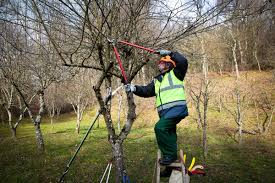
But what about if my neighbor, let’s call him Hank, is tickled by how he was able to prune the tree so well, and enamored with my high praise to the point that he just keeps going? I mean, if one tree is good, wouldn’t five trees be better? How about ten? And so Hank just keeps coming over, pruning trees. The problem is, I wanted to do it. And if I’m honest, I’m a little sick and tired of Hank always being out in my yard. I would actually like to take care of it myself, and it would be great to walk outside without having to chat about trees or trip over branches. Besides, Hank is getting a little too addicted to my approval and applause. I don’t know how to tell him, but old Hank has overstayed his welcome.
And that, my friends, is why it’s easier to open the gate and let someone in than it is to escort them out and lock it behind them.
I’m betting we’ve all experienced this over-help on some level. Perhaps you’re someone who likes to help and doesn’t know when to quit, or you’ve needed help in the past and now you aren’t sure where your life ends and the other person’s begins. Too much of anything, even the best chocolate in the world, is not good.
Proverbs 25:16 says, “If you find honey, eat just enough—too much of it, and you will vomit.”
And if that isn’t clear, read the verse that comes next!
“Seldom set foot in your neighbor’s house—
too much of you, and they will hate you.” (Proverbs 25:17)
It is a simple principle in theory, but tougher to watch play out in real life. When I’ve found myself wanting to help too much, or become over-responsible for something, these are a few questions I ask in the mirror:
Has this person asked me to help them? Or was it all my idea? Am I stepping on their toes and claiming that I’m just teaching them to dance?
Is this someone else’s responsibility? For example, am I offering a lot of advice or health know-how or financial help, but this person should be going to their spouse or their parent or their doctor? (Or their bank!)
Can they do it themselves? Really. Maybe it will be harder for them, sure. But if a person can do a thing themselves, let them. It’s better for everyone in the long run.
Is this the proverbial teach a man to fish scenario? Am I giving a fish for a day’s eating, or teaching how to fish for a lifetime?
…and last but definitely not least…
Is this about me?
Am I helping because it gives me a sense of purpose, because I enjoy the praise, or because I’m trying to control the outcome? This is the most revealing question to ask. If it is somehow more about me and my needs and not really much to do with what is actually good for that person – I need to hold up. Just stop. Sure as shootin’, if it’s about me at the core the situation will turn ugly. Maybe not for a long while, but it will.
Let’s check in on Hank.
There he is, sitting in his backyard on one of those Adirondack chairs. His head is hanging a bit low. He’s holding a cup of coffee and staring at the ground. I knock on the fence post.
“Hey, Hank.”
“Oh, it’s you. Hi.”
“Yeah…sorry about last week. I shouldn’t have thrown your saw into the street and chucked your shears over the fence like that.”
Hank is quiet.
“I mean, I did appreciate your help the other day. It’s just… it got too much, ya know?”
Hank looks up at me as I’m peering over the fence. “I get it. I always do this. I don’t know when enough’s enough.”
“Me too, Hank. I was so happy to have that tree fixed, and then I just didn’t know how to say no. I didn’t want to hurt your feelings. But then I lost it.”
Hank stood up and walked over. “It’s ok, honestly. I should have asked you. It’s just that I love pruning things and I’ve missed doing it since I retired.”
“That’s ok man, I mean you do a great job. How about if I ask a few friends if they need a tree or two taken care of?”
“Yeah, that might be good. That’d be great.”
“Just don’t camp out in their yard, ok Hank?”
Hank laughs a little and we shake hands.
“Oh, fer sure, fer sure.”
“Hey, do you have any more of that coffee?”
And Hank and I lean our shoulders into the fence that’s between our two property lines, the cedar planks we settled on five years ago, the fence posts chosen and the money paid over a handshake. We sip some slightly burned coffee and mutter about the state of potholes and the potential for flooding this summer. Perhaps the old lines of that poem are true: “Good fences make good neighbors”.
“Therefore encourage one another and build each other up, just as in fact you are doing.” 1 Thessalonians 5:11
(Robert Frost, “Mending Wall“, 1914)

 Stories for Humans